
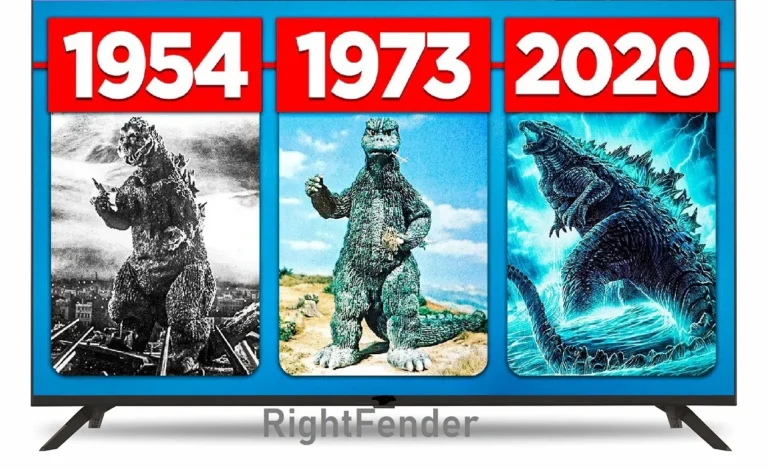
The evolution of Godzilla from 1954 to 2023 reflects both the changing technology of filmmaking and the shifting cultural landscape. Here’s a detailed look at how Godzilla has evolved over nearly seven decades:
1954: The Original Godzilla
- Film: Gojira (1954)
- Appearance: The original Godzilla was portrayed as a menacing, lumbering creature, a symbol of nuclear devastation following World War II. The suit was made from latex and rubber, giving Godzilla a bulky, almost prehistoric appearance.
- Theme: Godzilla served as a metaphor for the destruction caused by atomic bombs, reflecting Japan’s trauma post-Hiroshima and Nagasaki.
1960s-1970s: The Showa Era
- Films: Godzilla Raids Again (1955), King Kong vs. Godzilla (1962), Destroy All Monsters (1968), etc.
- Appearance: Over the years, Godzilla’s look became less terrifying and more anthropomorphic, with a friendlier face and less menacing features. The suit evolved to allow for more movement, enabling more dynamic battles with other monsters.
- Theme: The tone of the films shifted, with Godzilla often portrayed as a hero or anti-hero rather than a villain. The movies leaned into more fantastical elements, with Godzilla battling a variety of kaiju (monsters).
1980s-1990s: The Heisei Era
- Films: The Return of Godzilla (1984), Godzilla vs. King Ghidorah (1991), Godzilla vs. Destoroyah (1995)
- Appearance: Godzilla’s design became more intimidating again, with a bulkier frame, sharper dorsal fins, and a more aggressive posture. The special effects improved, giving Godzilla a more lifelike appearance with detailed textures.
- Theme: The films returned to more serious tones, with Godzilla often depicted as a force of nature—unstoppable and indifferent to human concerns. The storylines frequently focused on environmental issues, reflecting global anxieties about nuclear power and natural disasters.
1998: The American Godzilla
- Film: Godzilla (1998)
- Appearance: This version of Godzilla, produced by TriStar Pictures, was a radical departure from the Japanese designs. It was sleeker, more reptilian, and significantly faster, with a pronounced jawline and a more agile build.
- Theme: The film reimagined Godzilla as a mutated iguana caused by nuclear testing. While the film was a commercial success, it was criticized for straying too far from the original concept, leading to this version being informally dubbed “Zilla” by fans.
2000s: The Millennium Era
- Films: Godzilla 2000 (1999), Godzilla: Final Wars (2004)
- Appearance: Godzilla returned to a more traditional design with some modern updates, like sharper spines and a more dynamic movement. The creature was given a more rugged texture, with more detailed scales and a more expressive face.
- Theme: The Millennium series offered a mix of standalone stories and sequels, exploring various scenarios where Godzilla was both a destroyer and a savior.
2014-Present: The Reboot and MonsterVerse
- Films: Godzilla (2014), Godzilla: King of the Monsters (2019), Godzilla vs. Kong (2021)
- Appearance: The Legendary Pictures’ MonsterVerse introduced a massive, towering Godzilla with a more realistic, animalistic design. The creature has a bulky frame, with thick legs and powerful arms, and its atomic breath is a signature weapon.
- Theme: The modern films balance spectacle with deeper themes, often portraying Godzilla as an ancient alpha predator, a force of nature meant to restore balance. The franchise now includes a shared universe with other iconic monsters like King Kong.
2021-2023: Godzilla in New Media
- Films and Series: Godzilla Singular Point (2021), Godzilla Minus One (2023)
- Appearance: In recent years, Godzilla has appeared in various forms, including animated series like Godzilla Singular Point, which offers a new interpretation of the character, blending classic elements with modern animation styles.
- Theme: The latest entries continue to explore Godzilla’s role as both a destroyer and a protector, often incorporating cutting-edge CGI to bring the creature to life in ways that were unimaginable in 1954.
2023: Godzilla Minus One
- Film: Godzilla Minus One (2023)
- Appearance: This latest iteration of Godzilla revisits the original 1954 themes, portraying the creature as a symbol of destruction and fear. The design remains faithful to the classic look but incorporates modern effects to enhance realism and terror.
- Theme: The film returns to Godzilla’s roots as an unstoppable force of nature, symbolizing the devastation and trauma of war, much like the original film.
Conclusion: The Legacy of Godzilla
Godzilla has evolved significantly from its 1954 origins, reflecting the technological advancements and cultural shifts of each era. What began as a symbol of nuclear horror has transformed into a global icon, representing different themes and ideas over the decades. Despite these changes, Godzilla remains a powerful figure in pop culture, embodying humanity’s complex relationship with nature, technology, and its own destructive potential.
We hope you found this article helpful. If you did, be sure to check out our blog for more great content like this.